Bible Chat - Holy Bible Study
- 4.9
- Rating
- 5.00M
- Installs
- Free
- Price

 Analysis by App-foxy
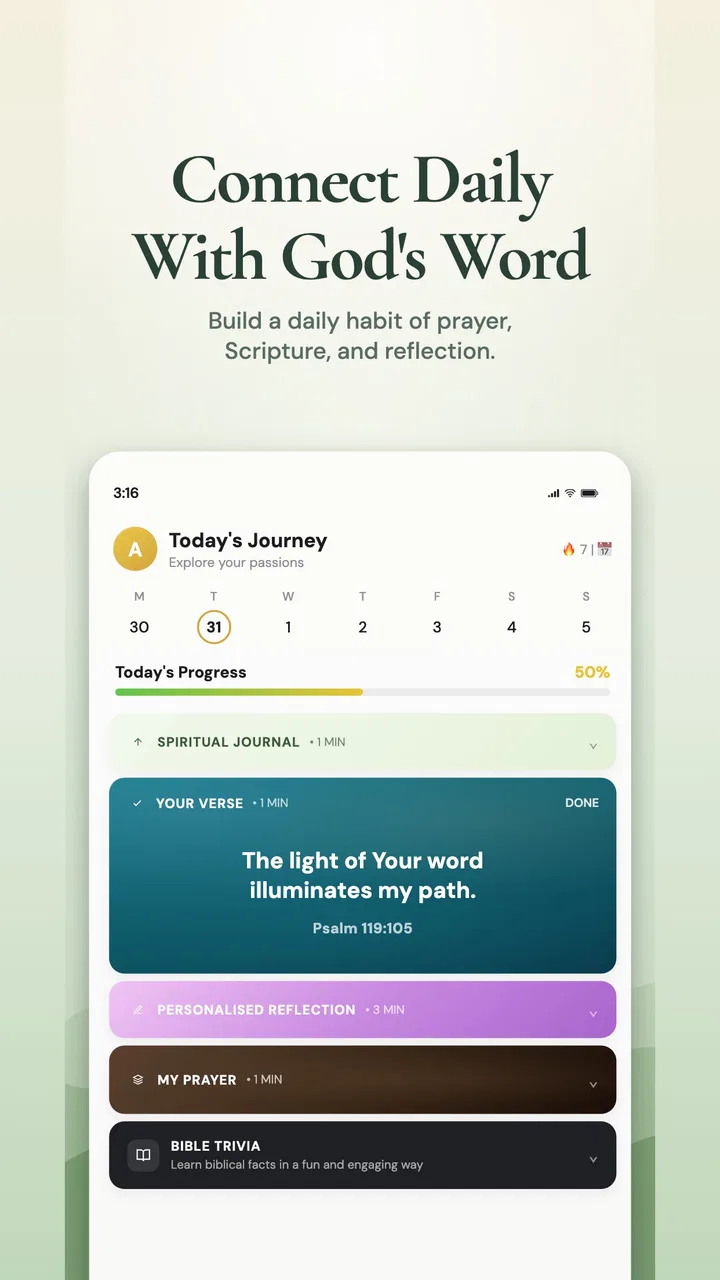
I found Bible Chat: Holy Bible Study most useful when I treated it as a small, ready-to-open companion rather than a replacement for a complete Bible study library. It sits in the Books & Reference category, comes from Bookvitals, and combines a verse-of-the-day approach with encouraging Bible reading, devotionals, prayer, audio material, and a chat-style way to explore faith-related questions. That mix makes it feel more conversational than a traditional Bible reader.
My first impression was that the app is designed for brief moments. It suits the few minutes before work, a quiet pause during lunch, or a reflective routine before bed. The strongest part is not simply having religious text on a phone; it is the way the app tries to turn a passing thought into a guided moment of reading or prayer. Its real value depends on how comfortably it fits into your daily rhythm.
The app is free to install and is suitable for Everyone, which makes the basic entry point approachable for families and new readers. It has built a sizeable audience, with more than a million installs and an average rating of 4.8 from roughly 74 thousand ratings. Those figures suggest that the short-form, conversational format works well for many people, although popularity alone does not tell me whether it will match your preferred translation, study depth, or privacy expectations.
You May Also Like

 Blood Strike: 2.5 Anniversary
Blood Strike’s Loadouts Turn Every Drop Into a Tactical Gamble
A close look at Blood Strike’s custom loadouts: how fast access to signature weapons reshapes its battle royale rhythm, rewards preparation, and narrows the gap between fights.

 Pandora - Music & Podcasts
Pandora’s Music Is Easy to Start, but Harder to Recover
Pandora’s strength is its low-effort path from a seed to a station. Its weak spot is how much confidence it asks you to place in connection, setup, and quiet recovery.

 8 Ball Pool
 Is Built on Rivalries, Rematches, and Routine
A close look at the rivalries, rematches, shared routines, and unanswered safety questions that turn a quick pool match into a persistent mobile community.

 Samsung Music
’s Quiet Strength Is Playing What You Already Own
Its reach comes less from spectacle than from dependable access to a personal library. That simplicity is both the app’s strongest retention engine and its ceiling.

 AccuWeather: Weather Radar
AccuWeather Review: A Quick, Clear Forecast for Everyday Decisions
For everyday plans, the best forecast is the one you can understand quickly. AccuWeather makes rain timing, radar, and local conditions easy to act on, with a few trade-offs.

 Hill Climb Racing
Why Hill Climb Racing Still Turns Crashes Into One More Run
A tiny car, a bumpy hill and one more upgrade: Hill Climb Racing keeps resurfacing because its simple chaos makes every near-miss feel personal.
More From Our News Desk



How Bible Chat feels when your connection is part of the experience
I find the connection question most useful when deciding where Bible Chat belongs in a real routine: it can make a short, interactive reflection feel easy to start, but it also shapes how smoothly that moment unfolds. I’d treat reception and available time as part of choosing the right session, rather than assuming every feature will suit every setting. That practical trade-off leads naturally to the question of what a connected session actually feels like.
Short sessions work best when the network is available
The most natural use of Bible Chat happens when the phone is connected and I have enough time for the app to load its different pieces. A verse can start the session, while a devotional or prayer prompt gives it direction. The chat element is especially suited to moments when I have a question in mind but do not want to search through a long commentary or open several reference books.
That convenience also means the experience is shaped by connectivity. A connected session feels more fluid because the app is built around current, interactive content rather than only presenting a static page. If I am moving between a verse, a devotional thought, and a question, the network becomes part of the handoff between those activities. This is worth remembering if you expect every part of a Bible app to behave like a downloaded book.
I would not use the chat as my only source for serious theological research. It is better at helping me begin a reflection, frame a question, or find a related direction than at replacing a study Bible, a trusted pastor, or a carefully sourced commentary. The conversational format can feel friendly, but friendly guidance still deserves discernment, especially when a question involves doctrine, grief, relationships, or a major life decision.
A useful phone companion in ordinary mobile situations
On a phone, the app makes sense for small windows of attention. I can imagine opening it while waiting for an appointment, taking a short break after a stressful message, or setting aside a few minutes before sleep. The verse-of-the-day format lowers the effort needed to begin. I do not have to decide which book to open first, and that matters on days when concentration is limited.
A realistic routine would be to read the daily verse in the morning, ask the chat a focused question about its theme, and return later for a prayer or devotional session. I would keep the question narrow rather than typing a broad request such as “explain everything about faith.” A prompt about patience, forgiveness, fear, or gratitude is more likely to produce something I can actually reflect on and apply during the day.
The audio Bible and prayer-focused material add another option for users who do not always want to stare at a screen. That can help during a quiet household task or a wind-down routine. I would still be careful in public spaces, since audio changes the privacy of the experience and may require headphones. The app is most flexible when I choose the format that suits the moment instead of trying to use every feature in every session.
What happens when the connection is weak
The main friction appears when the network is unreliable. A slow connection can interrupt the transition from a verse to an interactive response, delay audio-related content, or make a short devotional session feel less immediate. That is not necessarily a flaw unique to this app; it follows from using connected, conversational features. Still, it changes how dependable the app feels in places such as underground transport, crowded venues, rural areas, or buildings with inconsistent reception.
My practical advice is to start important reading or prayer time before you are already in a poor-signal situation. If you know you will be traveling, do not wait until the journey begins to discover whether the material you want is available at that moment. The app works best as a connected companion, so a little preparation can prevent a reflective session from turning into repeated loading attempts.
I also would not make it the sole plan for a retreat, a long flight, or an emergency moment when access to a network is uncertain. A physical Bible, a separately prepared reading plan, or another resource designed around stored content is a better backup for those circumstances. That comparison is important: Bible Chat offers immediacy and interaction, while a conventional printed or fully stored resource offers greater independence from reception.
Recovering from interruptions without losing the moment
Phone use is full of interruptions. A call, a notification, an accidental swipe, or a switch to another app can break the calmest reading session. With Bible Chat, I would treat recovery as part of the routine rather than assuming every session will unfold perfectly. If a response takes too long, I would avoid repeatedly tapping the same control. Waiting briefly, returning to the previous screen, and reopening the intended section is usually a calmer approach than creating several overlapping requests.
When the app does not respond as expected, the first checks are simple: confirm that the phone still has a connection, close other demanding apps, and reopen Bible Chat if the screen appears stuck. If the problem affects only an interactive feature, I would continue with a verse, devotional, or prayer section rather than abandoning the entire session. This is one of the app’s advantages as a collection of related activities: a temporary problem in one path does not have to end the whole routine.
There is also a mental recovery step. If an interruption happens during a difficult personal question, I would write down the question or a few key words before trying again. That keeps the reflection from depending entirely on one uninterrupted chat exchange. It also encourages me to judge the answer thoughtfully instead of accepting the first convenient response simply because I am eager to get back to the conversation.
Using mobile data with a little more care
People who rely on a limited mobile plan should pay attention to how they use the app. Text-based reading and short prompts are likely to be less demanding than audio, but I would not assume that every section has the same network impact. Audio Bible listening is the feature I would reserve for a stable connection or a situation where I have consciously decided that the convenience is worth the data use.
A sensible routine is to use Wi-Fi for longer sessions, especially when exploring several devotional topics or spending time with audio. On mobile data, I would keep the interaction focused: read the verse, ask one or two purposeful questions, and stop when the session has served its purpose. This is not only economical; it can make the experience more reflective by preventing endless browsing.
There is another kind of data-conscious use that matters: personal information. Chatting about faith can become intimate very quickly. I would avoid entering names, addresses, medical details, financial information, or private details about another person. Even when I am asking for spiritual encouragement, I can usually describe the situation in broad terms. That keeps the conversation useful without turning a devotional tool into a diary of sensitive personal records.
Free access, optional spending, and the right expectations
The app is free, but it includes in-app purchases ranging from $0.99 to $69.99 per item. That makes it important to explore the free experience first and understand which parts genuinely improve your routine before paying for anything. I would not subscribe or purchase simply because I enjoyed one encouraging session. I would first see whether I return to the verse, devotional, prayer, and audio features consistently.
This pricing range also means the app may suit different levels of commitment, but it can create uncertainty for someone who wants a completely predictable reading tool. If your priority is a straightforward Bible text with no interest in interactive extras, a conventional Bible app or a printed edition may be a better fit. Bible Chat earns its place when the additional guidance and conversational format are meaningful to you, not merely because the app contains religious content.
Who will benefit most, and who should choose something else
I would recommend Bible Chat to a reader who wants help starting a daily faith habit, a beginner who finds a large Bible difficult to navigate, or someone who appreciates asking questions in ordinary language. It is also a good match for users who alternate between reading, listening, prayer, and brief reflection instead of following one long study session.
I would be more cautious about recommending it to a scholar, a pastor preparing a detailed sermon, or a reader who needs extensive cross-references and source-critical tools. The app’s approachable tone is an advantage for personal reflection, but it is not the same as a comprehensive academic reference system. Likewise, users who spend much of their time offline should choose a resource built specifically around dependable stored access.
Readers who are sensitive to interruptions should also consider their habits. The interactive design can invite one more question, one more topic, or one more session when a simple reading was the original goal. I find that setting a clear purpose helps: “I want to reflect on patience for five minutes” is more useful than opening the app without any boundary.
What I would check before making it a daily habit
I would begin with a small test rather than committing to a complicated routine. Use the verse-of-the-day feature for several mornings, try one focused chat question, and sample prayer or devotional content at a different time of day. Then notice whether the app helps you reflect or merely gives you more screens to move through. That distinction is more important than the number of available features.
I would also check whether the wording and presentation feel comfortable for the way I read the Bible. Readers have different expectations about translations, tone, interpretation, and the amount of explanation they want. If the app’s conversational guidance feels too broad or too simplified for a particular topic, I would compare it with a trusted physical Bible or established study resource rather than forcing it to answer beyond its role.
The current version is 3.4.0.1 and it supports Android 8.0 or later, so compatibility is worth checking before installation on an older phone. Bookvitals has positioned the product as an accessible mobile app rather than a specialist desktop study environment. That is a strength for quick access, but it also explains why I see it as a companion for everyday practice instead of a full replacement for every Bible reference tool.
My connectivity verdict
For me, Bible Chat: Holy Bible Study works best when I have a reliable connection, a clear question, and only a few minutes to spare. The network enables the parts that make it distinctive: conversational exploration, guided reflection, and a flexible shift between reading, prayer, devotionals, and audio. When reception is poor, the experience becomes less dependable, so I would prepare a separate offline or physical resource for travel and low-signal situations.
That trade-off does not cancel out the app’s usefulness. It simply defines it. I would recommend it to someone who wants a welcoming way to begin or maintain a Bible habit on a phone, especially if interactive guidance feels more inviting than opening a large reference library. I would skip it in favor of a traditional Bible app or printed study Bible if uninterrupted access, deep scholarly tools, or minimal connectivity requirements matter more than conversation.
Overall, I see this as a thoughtful daily prompt rather than an authority that should make every spiritual decision for me. Used with reasonable privacy, careful judgment, and a backup for disconnected moments, it can turn an ordinary pause in the day into a focused period of reading or prayer. The best reason to keep it installed is not the feature count, but whether it helps you return to meaningful reflection consistently.
FAQs for Bible Chat - Holy Bible Study
01What is Bible Chat: Holy Bible Study app?
Bible Chat: Holy Bible Study is a mobile application designed to enhance your Bible study experience. It offers features like verse sharing, community discussions, and personalized study plans. The app aims to make the Bible more accessible and engaging through interactive and social elements.
02Is Bible Chat: Holy Bible Study app free to use?
Yes, the app is free to download and use. However, it may offer in-app purchases or premium features that provide additional content or functionalities. These can enhance the user experience, but the core features are accessible without any cost.
03Can I use Bible Chat offline?
Bible Chat provides offline access to downloaded Bible versions and study materials. This feature allows you to study and read the Bible without an internet connection. However, some features, such as community discussions, require online access to function.
04How secure is my data on Bible Chat?
The app prioritizes user privacy and data security by implementing robust encryption and privacy measures. It is important to review the app's privacy policy to understand how your data is collected, stored, and used, ensuring you are comfortable with their practices.
05Does Bible Chat support multiple Bible versions?
Yes, Bible Chat supports a wide range of Bible versions, allowing users to choose their preferred translation for study. This feature ensures that users can access the version that best suits their understanding and study preferences, making the app versatile for a diverse audience.
Pros
- User-friendly interface for easy navigation.
- Offers personalized daily Bible verses.
- Includes various Bible translations.
- Features a built-in prayer journal.
- Offline mode available for reading.
Cons
- Contains ads that may disrupt reading.
- Limited audio Bible options.
- Requires account for full features.
- Occasional app crashes reported.
- Limited customization of themes.

Bible Chat - Holy Bible Study
Gallery